Seeing The Invisible: How Thermography Empowers Electrical Reliability
In complex industrial facilities, electrical failures don’t always announce themselves with sparks or smoke. Often they begin quietly: a loose connection heating up, an imbalanced load creeping past its threshold, or insulation weakening over time. Thermography gives you the ability to “see” those hidden threats before they become emergencies.
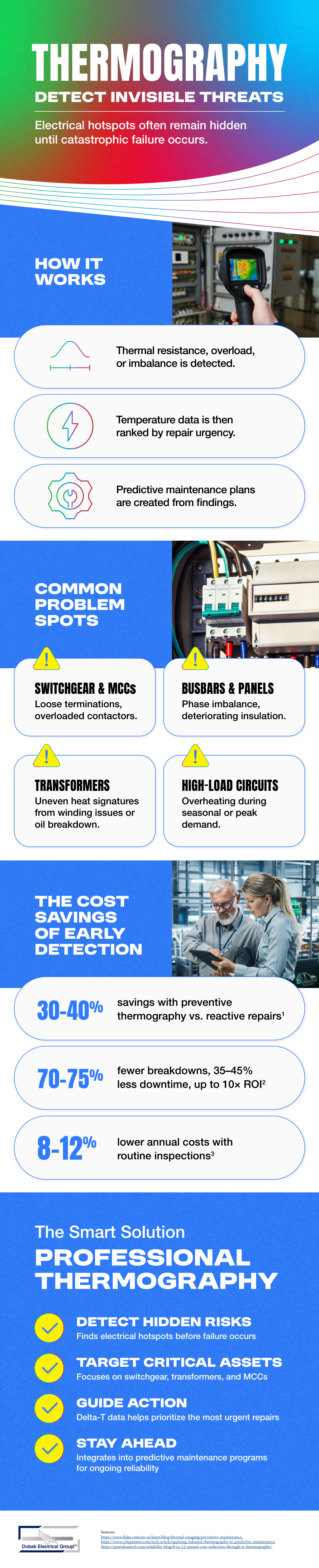
By using infrared imaging, thermography captures temperature patterns across equipment surfaces. What looks like a uniform metal surface in visible light can reveal alarming hot spots under infrared — the subtle signs of resistance, degradation, or overuse. In a successful program, those scans become part of a continuous diagnostic system rather than a one-time checkup.
Beyond just detection, good thermographic services deliver actionable insights. A technician will highlight anomalies, calculate temperature differentials (delta-T), and prioritize which components demand immediate attention. Over time, tracking heat signatures lets you spot trends — gradual rises or repeated stress points that often precede failure. And when that data is tied into your maintenance workflow or computerized maintenance system (CMMS), you can shift from reactive fixes to planned reliability.
In industrial plants and large facilities, thermography is especially valuable when applied to key infrastructure: switchgear, distribution panels, motor control centers, transformers, and high-load circuits. These are the systems under heavy stress, where failures cascade fast. Detecting wear or imbalance in those assets early can prevent ripple effects across operations, avoiding costly downtime and collateral damage.
Safety is another compelling benefit. Electrical fires are among the most damaging and hardest to contain. Catching hotspots before they ignite insulation or wiring reduces that hazard significantly. Thermography also supports compliance with safety practices and standards — inspections help you maintain documented evidence that your electrical systems are monitored, regularly inspected, and maintained.
Moreover, thermography is a cost-efficient investment. While the cost of scanning is modest, the cost of failure — equipment replacement, unplanned outages, lost production, and cleanup — can escalate quickly. In many plant environments the return is seen quickly because avoided disruption pays dividends.
To make thermography truly effective, success depends on partnership: working with technicians who are certified, experienced in industrial systems, and equipped with proper reporting tools. The imagery is important, but the value lies in the interpretation, trend tracking, and integration into your preventative maintenance roadmap.
Your electrical systems power everything — production, safety systems, controls. To treat them as opaque or “out of sight, out of mind” is a risk. Thermography lets you bring invisible weaknesses into view, make smarter decisions, and protect your operation before trouble strikes.
For a deeper dive into thermography and how it exposes hidden risks, check the companion material from industrial power contractors, Dubak Electrical Group.


You May Also Like
Ensuring Reliability in the Oil and Gas Industry: The Role of Preventive and Predictive Maintenance in Equipment Longevity and Operational Efficiency

The Lifecycle of Shipping Containers: From Global Freight to Domestic Use