Unseen Ignition Threats in Industrial Operations
Combustible dust remains one of the most underestimated hazards in industrial facilities. While safety programs often concentrate on major equipment failures or obvious fire risks, smaller and less visible dangers can quietly develop over time. Dust that settles out of sight can become a serious ignition threat, making prevention and early intervention far more effective than reacting after an incident occurs.
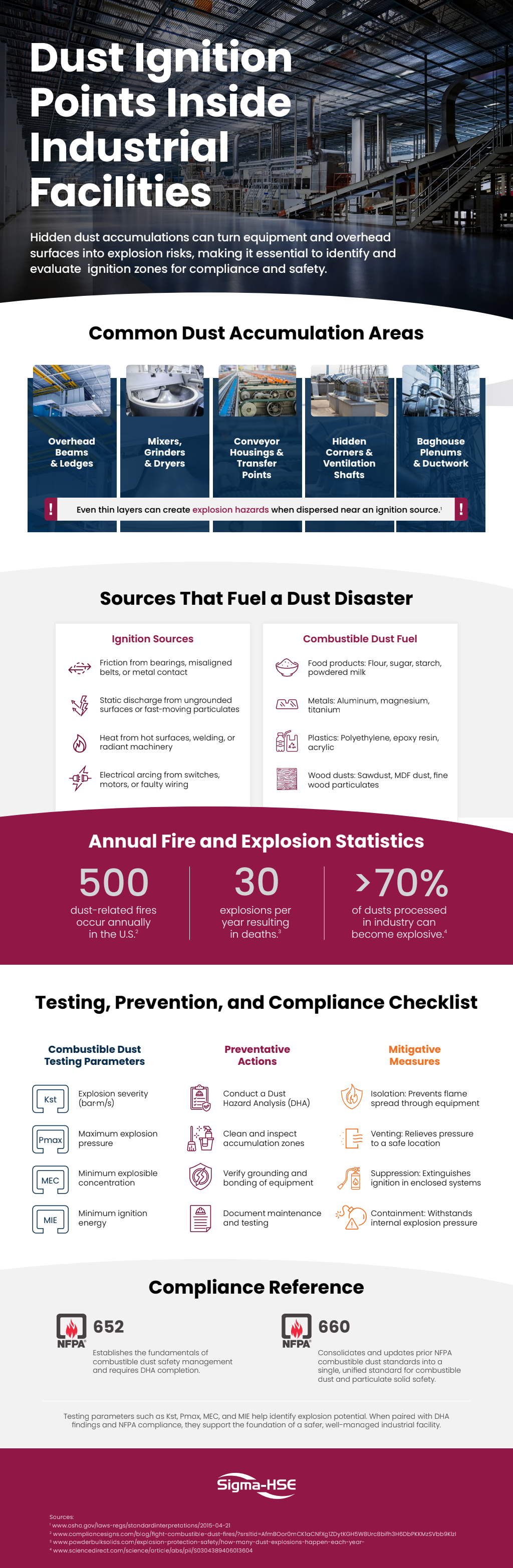
One of the reasons combustible dust is so dangerous is the way accumulation and ignition sources interact. Dust may collect gradually on overhead structures, inside ventilation systems, or along unused ledges without causing immediate concern. The risk escalates when an ignition source is introduced. Static discharge, friction heat, or contact with a hot surface can rapidly transform a passive dust layer into an active hazard. Many materials commonly handled in industrial processes can form fine dust that becomes highly combustible when dispersed or confined.
These risks are not limited to primary processing equipment. Areas such as conveyor housings, transfer chutes, and structural supports are often excluded from routine inspections and cleaning schedules. Because these locations are difficult to see or require specialized access, dust buildup can go unnoticed for long periods. Over time, even thin layers can reach a point where ignition becomes possible under the right conditions.
Ignition energy itself is often subtle. Static electricity generated by material movement, worn bearings, or misaligned belts can introduce enough energy to trigger combustion. At the same time, the characteristics of the dust play a critical role. Particle size, moisture content, and how dust is layered all influence how it reacts when exposed to energy. A thorough risk assessment must account for both the potential ignition sources and the behavior of the specific materials present.
Facilities that handle powders or bulk solids benefit from a structured and well-documented safety strategy. This begins with identifying where combustible dust is generated and mapping all potential accumulation zones. Control measures can then be implemented to limit buildup, break ignition pathways through proper grounding and bonding, improve housekeeping practices, and install explosion protection systems where necessary. The goal is to maintain safe conditions consistently, not simply respond after a near miss or incident.
Training and workplace culture are equally important. Employees need to understand that explosion hazards are not confined to large piles of dust or visible spills. Thin coatings in hidden areas can pose just as much risk. Ongoing communication between maintenance, operations, and safety teams helps ensure these areas are monitored and that protective measures remain effective over time.
Regulatory frameworks, including those referenced by Sigma-HSE, provide valuable guidance for managing combustible dust hazards. However, meaningful safety improvements come from applying these standards in a way that reflects the specific conditions of each facility. By combining testing data, field observations, and operational experience, organizations can move beyond basic compliance and build resilient systems that reduce ignition risk and support long-term operational stability.
For additional information on identifying ignition sources, assessing combustible dust hazards, and implementing prevention measures, refer to the accompanying resource from process safety consultants, Sigma-HSE.