Plan a Column-and-Boom Station From the Torch Package Outward
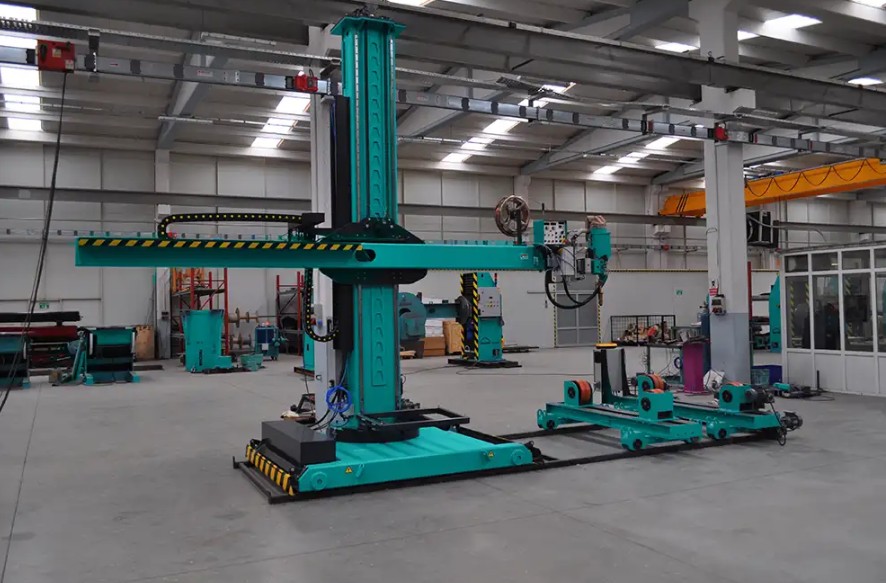
Column-and-boom stations are frequently discussed in terms of maximum reach or a model class. Those numbers matter, but they can create a false sense of simplicity. Booms do not carry only a torch. Depending on the process, they may carry a welding head, wire feeder, flux recovery, cross-slide, camera, seam-tracking hardware, cable package, service platform, and related brackets. Their duty also includes placing that package at the seam through the required lift and travel while the workpiece, support system, and operator access remain inside a workable envelope.
Size a manipulator from the complete boom-end package and production envelope outward. Start with the seam, map the workpiece and station, then build the full payload inventory. That approach makes it easier to compare configurations, identify when a rotator or positioner is needed to move the work, and avoid receiving a machine that reaches the nominal dimension but cannot carry or present the required welding package under real operating conditions.
Reach and payload change together
Reach and load are related because the equipment must support the actual mounted assembly across the actual operating envelope. Compact welding heads can lead to relatively modest packages, while a submerged-arc setup may add a wire feeder, flux system, recovery hardware, cross-slide, and additional services. Camera or seam-tracking arrangements may improve the process review but still need to be included in the mechanical and routing plan. Treating the torch alone as the payload can make a quotation look adequate before the complete package has been defined.
Aubrik’s column-and-boom information describes manipulator configurations for carrying and travelling a welding head, with representative classes and variable travel ranges. Its guidance specifically advises that boom-end loading should include the welding head, wire feeder, flux-recovery unit, camera, cross-slide, and any platform rather than just the torch. That is a sound procurement discipline: each item affects the selected configuration and must be confirmed for the proposed machine.
Start with a drawing of the longest and most difficult seam, not the easiest repeat job. Identify the workpiece diameter or height, seam location, required torch angle, travel direction, clearance for the welding head, and any inspection or maintenance position. Then add the part motion. With a rotating workpiece on separate support, the relationship between boom path and work motion must be intentional. For fixed workpieces, boom and column must provide the required coverage without unsafe access or a compromise in the welding position.
Make a Boom-End Inventory Before Choosing a Class
Called the Boom-End Inventory, this pre-quotation document is useful for this type of station. Inventory lines list every component that moves with the boom and ask the buyer to state whether the component is permanently mounted, process-dependent, or a possible future addition. This prevents the common mistake of selecting around today’s minimal torch package and discovering later that a planned process option has no place in the load or cable plan.
Package item Question to answer Why it affects the station
Welding head and torchWhich process, head geometry and mounting interface are required?Sets the basic presentation and reach condition
Wire feeder or flux hardwareDoes it travel with the head, and where are consumables routed?Changes carried load, service route and maintenance access
Cross-slide and seam trackingWhat adjustment travel and sensing hardware are planned?Affects package length, mounting stiffness and commissioning scope
Camera or inspection aidIs it continuous process equipment or occasional verification equipment?May add load and require protected cable routing
Platform and operator accessWhat work occurs at height and who needs access?Influences layout, controls and safety planning
Future optionsWhich additions are likely within the project life?Lets the supplier state whether a later upgrade remains practical
Attach masses, mounting dimensions, and service requirements where they are known. Where they are not known, mark them as open items rather than assuming a generic allowance. This gives a supplier a transparent basis for its proposal and helps procurement compare whether different offers include the same package assumptions. The record also gives the project team a clear list of what needs confirmation before a purchase order is released.
Use the Reach-Envelope Review
Reach should be reviewed as a three-dimensional production envelope, not a line drawn from the boom tip to a seam. Named the Reach-Envelope Review, this review combines horizontal boom reach, column lift, workpiece position, head offset, torch angle, support elevation, and safe clearance. Review the full seam path, loading and unloading, inspection, and a maintenance position for the mounted equipment.
Use a layout drawing or simple scale model to test the envelope. Ask whether the head can reach the start and end of the seam without moving into a restricted area. Check whether the column needs travel, whether the workpiece support needs a different elevation, and whether hoses and cables maintain safe routing through the entire path. For a large vessel on rotators, the review should cover both boom travel and the cylinder’s rotating surface at the expected working position.
Aubrik lists four reference manipulator classes on its current category page and identifies boom reach, column lift, boom-end load, power source, seam tracking, and flux feed or recovery as configuration variables. These references support an initial discussion, but they are not a guarantee that a generic class will match a given job. Buyers should request the proposed reach, lift, payload assumptions, and limitations in the quotation for the actual layout.
For quotation comparison, Aubrik lists variable travel of 120 to 2,000 mm/min and reference classes that include AM-CB-30 at 3 x 3 m with 150 to 300 kg boom-end load, AM-CB-40 at 4 x 4 m with 300 to 600 kg, AM-CB-50 at 5 x 5 m with 500 to 1,200 kg, and AM-CB-60 at 6 x 6 m with 800 to 2,000 kg. These are manufacturer-listed classes and ranges, so final reach, payload, process package, and duty must be confirmed for the proposed station.
Pair work motion with head motion deliberately
Manipulators normally move the welding head; they do not normally rotate the workpiece. Large cylindrical work therefore often needs another system, such as a rotator, when the process requires the joint to turn under a fixed or travelling head. Clamped workpieces may instead be presented by positioners. Correct architecture depends on seam orientation, workpiece geometry, part mix, handling method, and required process access.
Do not describe one layout as universally better. Rotator-plus-manipulator stations can make sense for long cylindrical seams when the workpiece needs controlled rotation and the head needs travel. Different part families may be better served by clamped positioners, robot cells, or stationary fixtures. Planning value lies in stating which element moves the work, which moves the head, and how their controls are coordinated for the actual weld sequence.
For a buyer considering column-and-boom reach planning, this architecture question should be answered before a model name is selected. Aubrik can provide configuration information for manipulators and related welding automation, but the recommended route should be tested against the part, seam, payload inventory, and proposed cell layout rather than a generic capacity target.
Ask for a quotation that records configuration assumptions
Well-scoped quotations should state the equipment setup in sufficient detail to compare it with the Boom-End Inventory and Reach-Envelope Review. Request the proposed boom reach, column lift, stated boom-end load, travel control, head-mounting arrangement, power and service routing, optional seam tracking or flux equipment, workpiece-motion interface, controls, and any limits the supplier has assumed. Where a current requirement is outside a standard setup, make that visible rather than leaving it as an expectation after delivery.
Ask what evidence will be used in acceptance. Evidence may include a representative workpiece, a documented payload, a travel demonstration across the defined seam path, an inspection of cable routing, and a functional test of controls and stops. When the final part is unavailable, record where the substitute differs. The goal is not to simulate every production condition in a factory test; it is to avoid treating a minimal demonstration as proof that the actual configuration has been covered.
Retain the completed inventory and envelope drawing after commissioning. They become useful when a new welding head, a larger wire package, a revised vessel diameter, or a different process is introduced. Earlier selections do not automatically approve changed payloads or envelopes. Updating the documents is faster and safer than discovering the gap through an overloaded or inaccessible setup.
Plan access, controls, and maintenance with the payload.
Stations that reach the seam can still be difficult to operate if controls, maintenance points, and inspection positions are overlooked. Define where the operator starts and stops travel, where process adjustments are made, how consumables are replenished, and which components require service access. Include normal recovery after a planned stop and the route for a fault condition. These details affect platform needs, cable routes, cell layout, and the practical use of the machine.
Where a project involves pressure-retaining fabrication, distinguish the movement system from the qualification boundary. ASME BPVC Section IX addresses qualifications for welding, brazing, and fusing procedures and personnel in connection with construction codes. Manipulators can support a repeatable work route, but they do not make the equipment or the resulting weld automatically code-qualified. Applicable code, project specification, procedure, personnel, and inspection plan remain separate requirements.
ISO 12100 describes a general machinery risk-assessment and risk-reduction approach. Use that boundary when reviewing platform access, cable movement, controls, and maintenance space around the complete boom-end package.
Limitations: equipment travel does not qualify the weld
Both named reviews make a manipulator request more precise, but they do not replace structural review, electrical design, machine risk assessment, welding-procedure qualification, or operator training. They cannot correct poor fit-up, unsuitable process parameters, material variation, or an inadequate inspection plan. Fast travel ranges or large nominal loads do not by themselves establish weld quality or production readiness.
Manufacturer-listed ranges and reference classes should be treated as configuration starting points. Final suitability depends on the exact package, reach, lift, part geometry, workpiece motion, duty, controls, local safety requirements, and quote-level confirmation. When planning begins at the torch package and works outward through the production envelope, the resulting column-and-boom station is more likely to serve the seam it was bought to support. Before sign-off, compare the final installed package with the original inventory line by line, including brackets, sensors, cables, and service hardware, because a late addition that appears small on a purchasing list can change reach, loading, routing, or maintenance access once the station is assembled around the real workpiece. During a mock-up or acceptance trial, move the head through the full seam path while the intended work support, cable bundle, access platform, and representative welding package are present, then record every clearance, routing, control-reach, and maintenance observation in a way that lets the buyer decide whether a minor layout change is required before a production part makes the same limitation expensive to correct.


You May Also Like
How Advanced Materials and Precision Machining Are Shaping the Future of Manufacturing

Fitness-for-Service Assessment of Aging Manufacturing Equipment: Remaining Life, Structural Integrity & Failure Prevention