Why Manufacturing Is Important: 10 Key Benefits for the Economy and Society
I’ve always found it interesting how much work happens behind a single finished product. A simple steel bracket, for example, might require raw material preparation, cutting, machining, welding, inspection, and finishing before it is ready for use. Each step requires the right equipment, skilled workers, careful planning, and attention to quality.
So, why is manufacturing important? Manufacturing creates jobs, supports economic growth, encourages innovation, strengthens supply chains, and provides the products that people and businesses depend on every day. It also helps countries develop technical skills, increase productivity, and become more competitive in global markets.
Let’s explore the main reasons manufacturing matters, from its role in everyday life to its impact on technology, employment, and long-term economic development.
What Is Manufacturing?
Manufacturing is the process of transforming raw materials, components, or parts into finished or intermediate goods using tools, machinery, labor, and production processes.
It includes traditional activities such as metal fabrication, woodworking, textile production, and food processing, as well as advanced operations involving robotics, computer numerical control (CNC) machining, and automated assembly lines.
For example, a manufacturer producing steel machine parts may begin with a metal bar or plate. The material is cut to size, machined to meet dimensional requirements, inspected for accuracy, and prepared for delivery to a customer.
Manufacturing can be divided into several broad categories:
-
Discrete manufacturing: Producing individual items such as cars, appliances, machinery, and electronic devices.
-
Process manufacturing: Producing goods through formulas or continuous processes, such as chemicals, beverages, and certain pharmaceutical products.
-
Fabrication and assembly: Cutting, forming, welding, and joining materials to create products or structures.
-
Advanced manufacturing: Using technologies such as robotics, automation, digital monitoring, and advanced materials to improve production.
These activities support many other industries, including construction, healthcare, agriculture, transportation, and energy.
1. Manufacturing Creates Jobs and Career Opportunities
One of the most important reasons manufacturing matters is its ability to create employment.
Factories need people with different skills to design products, operate machines, maintain equipment, inspect quality, manage inventory, coordinate production, and deliver finished goods. Manufacturing employment also supports jobs in transportation, warehousing, engineering services, and industrial supply businesses.
Skilled and Technical Jobs
Modern manufacturing offers career opportunities beyond traditional assembly-line work.
Workers may become CNC machinists, welding technicians, industrial maintenance specialists, production supervisors, quality inspectors, manufacturing engineers, or automation technicians.
These roles often require technical training and practical experience. For example, a CNC machinist needs to understand engineering drawings, cutting tools, workholding methods, machining parameters, and measurement techniques.
When workers develop these skills, they can become valuable contributors to production efficiency and product quality.
Indirect Employment Opportunities
Manufacturing also supports jobs outside the factory itself.
A company producing industrial pumps may purchase steel from suppliers, use trucking companies to transport components, hire maintenance contractors, and rely on software providers to manage production data.
This creates an interconnected network of employment opportunities.
For communities with a strong manufacturing base, these connections can support local businesses and create demand for technical education and vocational training.
2. Manufacturing Drives Economic Growth
Manufacturing contributes to economic growth by adding value to raw materials and creating products that businesses and consumers can purchase.
Consider the difference between selling raw steel and turning that steel into precision machine components. The finished components require additional processing, equipment, labor, engineering knowledge, and quality control.
These activities create economic value beyond the original raw material.
Increasing Economic Output
Manufacturing contributes to a country’s gross domestic product (GDP), which measures the value of final goods and services produced within its economy.
When manufacturers increase productivity, develop new products, or expand their operations, they can contribute to higher economic output.
The impact extends to other industries as well. Construction companies need building materials, agricultural businesses need machinery, and hospitals need medical equipment.
A productive manufacturing sector helps supply these industries while creating demand for goods and services from other businesses.
Supporting Local Economic Development
Factories can help communities develop by creating jobs and encouraging investment in roads, utilities, industrial facilities, and workforce training.
When manufacturing businesses purchase supplies locally and employ local workers, part of the economic activity may circulate through nearby communities.
The benefits depend on factors such as local sourcing, wages, working conditions, environmental practices, and how much of the business’s value remains in the region.
Manufacturing is not automatically beneficial in every situation, but responsible investment and effective management can make it an important driver of regional development.
3. Manufacturing Encourages Innovation and Technology
Manufacturing is important because it helps turn ideas and inventions into products that can be produced at scale.
An engineer may design a more efficient electric motor, but that design must still be manufactured consistently, tested for performance, and produced at a cost customers can afford.
Manufacturing provides the equipment, processes, and practical knowledge needed to make that possible.
Advanced Manufacturing Technologies
Modern factories increasingly use technologies such as:
-
Computer numerical control (CNC) machining
-
Industrial robots and automated assembly
-
Computer-aided design and manufacturing (CAD/CAM)
-
Sensors and real-time production monitoring
-
Artificial intelligence and predictive maintenance
-
Additive manufacturing, commonly known as 3D printing
These technologies can improve precision, reduce repetitive work, and provide better information about production performance.
For example, a CNC machine can produce complex components repeatedly when the program, tooling, setup, and machine condition are properly controlled. Automated measurement systems can then help verify whether critical dimensions meet the required tolerances.
Technology does not remove the need for skilled workers. Instead, it often changes the skills required to operate, maintain, program, and improve production systems.
Turning Research Into Practical Products
Manufacturing also supports innovation by helping researchers and businesses test whether new materials, designs, and technologies can be produced reliably.
A new battery design, medical device, or industrial sensor may work in a laboratory but face challenges when scaled to commercial production.
Manufacturing engineers must consider material availability, process repeatability, product safety, cost, and quality requirements.
This connection between research and production helps move useful inventions from the development stage into everyday use.
4. Manufacturing Supplies Essential Everyday Products
Manufacturing is deeply connected to daily life because it produces many of the goods people use at home, at work, and in public spaces.
Without manufacturing, it would be difficult to supply modern societies with the volume and variety of products they depend on.
Products Used in Daily Life
Manufacturers produce items such as:
-
Clothing, shoes, and household furniture
-
Smartphones, computers, and electrical appliances
-
Cars, motorcycles, bicycles, and vehicle components
-
Food products, packaging, and household supplies
-
Building materials, pipes, and construction equipment
These products may pass through several factories and distribution centers before reaching consumers.
A household appliance, for example, can contain metal parts, plastic housings, electronic circuits, wiring, fasteners, and motors sourced from different suppliers.
Manufacturing brings these materials and components together into a functional product.
Essential Products for Public Services
Manufacturing also supplies products used by hospitals, schools, emergency services, utilities, and transportation systems.
Medical equipment, electrical transformers, water treatment components, protective equipment, and public transportation parts all depend on manufacturing processes.
When these products are unavailable, essential services can face delays or increased costs.
This is one reason reliable manufacturing capacity matters beyond commercial profits: it supports the infrastructure and equipment that modern communities need.
5. Manufacturing Strengthens Supply Chains
A supply chain is the network of businesses and activities involved in sourcing materials, producing goods, and delivering products to customers.
Manufacturers sit at a central point in many supply chains because they transform purchased materials and components into products that other businesses or consumers need.
Supporting Other Industries
Consider the production of agricultural machinery.
The manufacturer may purchase steel, hydraulic components, tires, bearings, electronic controls, and engines from different suppliers. The finished machine then supports farmers, who use it to produce crops for food processors, retailers, and consumers.
A disruption at one supplier can affect several businesses downstream.
For this reason, manufacturers must coordinate purchasing, inventory, production scheduling, transportation, and supplier performance.
Improving Supply Chain Resilience
Reliable domestic or regional manufacturing capacity can help reduce dependence on a limited number of suppliers for certain critical products.
However, producing everything locally is not always practical or economical. Many industries depend on international supply chains because materials, expertise, and production capabilities are distributed around the world.
A stronger approach is to identify critical dependencies, maintain appropriate inventory for high-risk materials, qualify alternative suppliers where possible, and improve visibility across the supply chain.
Manufacturing capacity becomes especially important during natural disasters, transportation disruptions, or sudden increases in demand.
6. Manufacturing Supports International Trade and Exports
Manufactured goods are important products in international trade.
Countries export products such as vehicles, industrial machinery, electronics, chemicals, processed foods, textiles, and specialized equipment to customers around the world.
These exports can generate revenue, support jobs, and create opportunities for businesses to expand into new markets.
Competing in Global Markets
Manufacturers compete through product quality, cost, delivery reliability, technical performance, and customer service.
A company that consistently produces accurate components and delivers them on time may win contracts from international customers.
To achieve this, manufacturers often invest in employee training, process improvement, modern equipment, and recognized quality management practices.
Export success does not depend on low prices alone. Specialized products, reliable performance, and technical expertise can also create a competitive advantage.
Building Industrial Expertise
Export-oriented manufacturing can encourage businesses to improve their production processes to meet customer specifications and market requirements.
Over time, these capabilities may support the development of local suppliers, engineering services, and technical education.
For developing economies, manufacturing can offer opportunities to move from exporting primarily raw materials toward producing higher-value goods, although success depends on investment, infrastructure, skills, market access, and sound economic policies.
7. Manufacturing Improves Productivity and Efficiency
Manufacturing helps businesses produce more goods from available resources through better processes, improved equipment, and effective production management.
Productivity generally measures the output produced relative to the inputs used. Improving productivity does not necessarily mean asking employees to work faster; it can also mean eliminating waste, reducing defects, and improving machine reliability.
Reducing Waste in Production
Manufacturing processes often involve opportunities to reduce unnecessary material use, waiting time, excess movement, rework, and equipment downtime.
For example, a fabrication shop may discover that workers repeatedly walk across the workshop to collect tools. Rearranging the workstation and placing frequently used tools within easy reach can reduce wasted movement.
Similarly, improving a cutting program may allow more parts to be produced from each sheet of metal, reducing scrap.
Small improvements can add up when they are repeated across hundreds or thousands of production cycles.
Improving Quality and Consistency
Standardized work instructions, suitable tooling, process monitoring, and regular inspection help manufacturers produce goods that meet specifications more consistently.
In metal machining, for example, controlling tool wear and checking critical dimensions can reduce the risk of producing parts outside the required tolerance.
Better process control can reduce rework, scrap, warranty claims, and customer complaints.
The result is not only lower production cost but also greater confidence that the finished product will perform as intended.
8. Manufacturing Supports Infrastructure and National Development
Manufacturing is essential to building and maintaining the infrastructure that modern societies rely on.
Roads, bridges, factories, power stations, communication networks, water systems, and public transportation all require manufactured materials, equipment, and components.
Supporting Construction and Transportation
Construction projects depend on products such as structural steel, cement, glass, electrical equipment, pipes, and mechanical systems.
Transportation networks require vehicles, engines, signaling equipment, rails, and replacement components.
These products must be manufactured to meet relevant technical and safety requirements.
A reliable manufacturing sector can help supply infrastructure projects and support ongoing maintenance after construction is complete.
Supporting Energy and Utilities
Energy systems rely on manufactured products such as turbines, transformers, cables, pumps, batteries, and control equipment.
Renewable energy technologies also depend on manufacturing, including solar panels, wind turbine components, and energy storage systems.
As energy systems change, manufacturers must develop new production capabilities and improve existing technologies.
This makes manufacturing an important part of both economic development and the transition toward more efficient energy systems.
9. Manufacturing Promotes Skills Development and Education
Manufacturing creates demand for practical skills in engineering, mechanics, electronics, automation, quality control, logistics, and production management.
These skills can provide pathways into technical careers and support lifelong learning.
Developing a Skilled Workforce
Employees may learn how to interpret engineering drawings, operate machinery, use measurement instruments, troubleshoot faults, or maintain industrial equipment.
Vocational schools, technical colleges, apprenticeships, and workplace training programs can help workers develop these capabilities.
For example, a trainee machinist may begin by learning measurement and workshop safety before progressing to machine setup, tool selection, CNC programming, and process optimization.
As manufacturing technology develops, ongoing training becomes increasingly important.
Encouraging Problem-Solving
Manufacturing work frequently involves identifying the causes of production problems and finding practical solutions.
A quality inspector may investigate why a component fails a dimensional check. A maintenance technician may diagnose an unusual machine vibration. A production engineer may redesign a process to reduce cycle time.
These activities develop analytical thinking, teamwork, and technical judgment.
A skilled manufacturing workforce can therefore support improvements throughout the business, not just in the production department.
10. Manufacturing Can Support Sustainability and Resource Efficiency
Manufacturing has environmental impacts, including energy consumption, material extraction, emissions, waste generation, and water use.
At the same time, manufacturing can help reduce these impacts through better process design, efficient equipment, recycling, and more responsible material management.
The environmental outcome depends on the product, production method, energy source, and full life cycle of the goods being manufactured.
Reducing Material Waste
Manufacturers can use improved cutting layouts, precise machining, better quality control, and recycling programs to reduce the amount of material discarded.
In metal fabrication, leftover steel may be sorted and recycled rather than sent to landfill. However, reducing scrap at the source is usually preferable because producing and processing the original material also consumes resources.
Better production planning can help avoid unnecessary batches, obsolete inventory, and products that must be discarded.
Improving Energy Efficiency
Factories can evaluate energy consumption, maintain equipment, reduce compressed-air leaks, improve motor efficiency, and optimize production schedules.
For example, a poorly maintained motor or compressed-air system may consume more energy than necessary. Identifying and correcting these problems can lower operating costs while reducing energy use.
Some manufacturers also adopt renewable electricity or recover waste heat where technically and economically suitable.
Supporting the Circular Economy
A circular economy aims to keep products and materials in use for longer through durability, repair, reuse, remanufacturing, and recycling.
Manufacturers can contribute by designing products that are easier to repair, replacing components instead of entire assemblies where appropriate, and recovering valuable materials at the end of a product’s life.
These practices can reduce waste and create new business opportunities, although they require suitable product design, collection systems, and economically viable recovery processes.
Why Manufacturing Is Important for Developing Countries
Manufacturing can play an important role in economic development by creating industrial jobs, building technical capabilities, and expanding the range of products a country can produce.
For developing economies, the opportunity is not limited to building large factories. Smaller manufacturers can also contribute by producing components, processing agricultural products, repairing equipment, and supplying larger industrial businesses.
Adding Value to Local Resources
A country that produces agricultural goods or mineral resources may be able to create additional value by processing those materials into finished or intermediate products.
For example, processing agricultural products into packaged foods can create demand for food-processing equipment, packaging materials, logistics, quality testing, and distribution services.
The benefits depend on whether the resulting products can be produced competitively and sold at sustainable prices.
Strengthening Local Industry
Manufacturing development can encourage improvements in infrastructure, technical training, supplier capabilities, and industrial services.
However, these benefits are not guaranteed. Businesses also need access to finance, reliable electricity, suitable transport, skilled workers, appropriate technology, and predictable regulations.
Long-term progress generally requires investment in both industrial capacity and the wider environment that allows businesses to operate efficiently.
What Happens When Manufacturing Is Weak?
A country or region with limited manufacturing capacity may become more dependent on imported products, particularly when domestic alternatives are unavailable.
This can create risks if international supply chains are disrupted or imported goods become significantly more expensive.
Weak manufacturing capabilities may also limit opportunities for technical employment, industrial research, and the development of local suppliers.
However, importing goods is not inherently a problem. International trade allows countries to access products that other economies can produce more efficiently.
The challenge is to maintain a healthy balance between trade and domestic capability, particularly for strategically important products where supply disruptions could have serious consequences.
How Modern Technology Is Changing Manufacturing
Manufacturing continues to evolve through automation, digital systems, advanced materials, and data-driven production methods.
These technologies help businesses improve accuracy, monitor operations, and respond more quickly to changing customer requirements.
Automation and Robotics
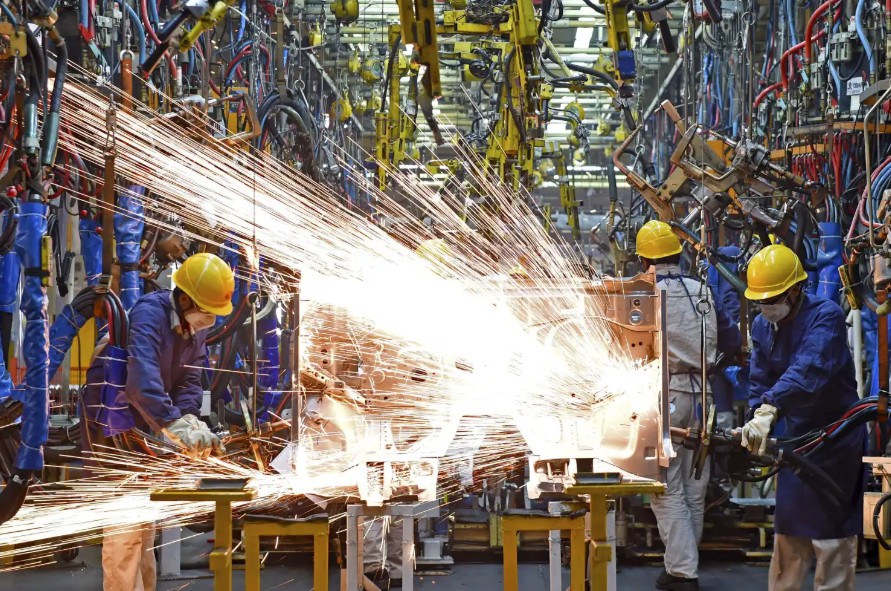
Industrial robots can perform repetitive tasks such as welding, material handling, painting, and assembly.
When properly selected and integrated, automation can improve consistency and reduce workers’ exposure to certain hazardous tasks.
However, robots require suitable tooling, programming, maintenance, guarding, and safety systems. Automation is most effective when the entire process is designed to support it.
Digital Manufacturing Systems
Software systems help manufacturers plan resources, track production, manage quality, and monitor equipment.
For example, an enterprise resource planning system can coordinate business-wide activities, while a manufacturing execution system can record production progress and process information on the factory floor.
When these systems share reliable data, managers gain a clearer understanding of production performance and can make better-informed decisions.
Additive Manufacturing and Advanced Materials
Additive manufacturing, or 3D printing, creates components by building material in successive layers.
It can be useful for prototypes, complex geometries, customized parts, and selected production applications. Advanced materials also allow engineers to develop products with specific strength, weight, temperature, or corrosion-resistance characteristics.
These technologies do not replace every traditional manufacturing process, but they expand the range of available production methods.
Conclusion: Why Manufacturing Matters
Manufacturing is important because it connects raw materials, engineering knowledge, skilled workers, and technology to produce the goods that modern society depends on.
It creates employment, contributes to economic growth, supports international trade, encourages innovation, strengthens supply chains, and supplies essential products for homes, businesses, infrastructure, and public services.
Manufacturing can also improve productivity and support more sustainable use of resources when companies invest in efficient processes, quality control, responsible material management, and better technology.
Ultimately, a strong manufacturing sector is not simply about producing more products. It is about producing useful goods safely, efficiently, reliably, and responsibly while creating opportunities for workers and businesses.
Whether it involves a small metal fabrication workshop or a highly automated industrial facility, manufacturing remains a vital part of how economies grow and how everyday life is supported.